
It’s five answers to five questions. Here we go…
1. Does it look bad to send a job application during work hours?
I have been at my current company for three years now and have been looking to change jobs off and on pretty much since day one. Sometimes the desire to leave gets so bad that I find myself browsing job listings during the work day, especially since we have been working from home due to the pandemic.
Does it reflect badly on me if an application or resume was received during business hours, considering the hiring manager or whomever would likely know, at least at some point, that I am currently working and in theory should be doing my job at that time. Any insight as to whether this would even raise an eyebrow? I wouldn’t want something as small as that to derail any chance I might have at being considered.
It is entirely possible that this is a non-issue and I have agonized for nothing. That is my MO, after all.
Tons of applications are received during work hours! Now that I think about it, most applications I’ve received have probably come in during work hours. It’s not weird at all.
Employers generally won’t pay any attention at all to the time it came in. If for some reason someone ever thought about it, they’d assume you were off for the day or working different hours; they’re not going to jump to “she was obviously sending this when she was supposed to be working.”
That said, doing this from work can cause problems with your current employer. Since you’re working remotely now, it might be less of an issue, but doing it from the office is something that can be seen on your employer’s network if they bother to look — and it can really cause problems for you (up to and including being fired).
2. My professional name is different from my social name
When I graduated and started my career, I decided to go by my middle name professionally. It’s gender-neutral (though typically assumed to be male) and kind of unusual for a first name — let’s say “Gates.” I mostly wanted my online presence to be different from the name I go by in my personal life, and I like keeping my personal and professional lives separate. Most people assume I’m a guy until we talk on the phone or meet in person. I know it’s a strange practice, but I really value my privacy and the perks of gender neutrality.
My first name is already a nickname that isn’t immediately obvious as a nickname (think “Elle” to “Penelope”), and I’ve been in awkward scenarios where I ended up having to reveal all three names for paperwork reasons.
I’m realizing that it’s more complicated than I anticipated to go by two different names in the same city. In all professional contexts, I’m “Gates,” but I’ve made friends through a hobby in my new city as “Elle.” When asked about my unusual name in work scenarios, I tell the truth that it’s a middle name. I try to stay consistent per scenario and not confuse people. But not all scenarios are clear-cut personal vs. professional. Some things could be potential networking opportunities. Plus, I wasn’t expecting to make real friends at work, but I’ve since attended parties with them and brought them to my hobby events, where people called me my two different names.
I feel like if I treat it as a non-issue, it’ll mostly be a non-issue, but I’m worried that it comes across as weird or unnecessarily secretive and untrustworthy. I don’t know the protocol here. Have I dug myself into a hole? Am I overthinking this? I’m still young and pretty new in my career, so I’d really appreciate any advice you might have.
Yeah, it’s hard to use two entirely separate names in different parts of your life. Not impossible but hard. It’s not uncommon to use a nickname socially but your full name professionally (like Elizabeth and Liz), but when work knows you as Gates and friends know you as Elle, it’s going to cause confusion. Worlds don’t always stay perfectly separate like that; there’s crossover, as you’re finding.
That’s not insurmountable if you’re committed to doing it. Some people will find it odd. A lot of people will find it confusing and have a “wait, what?” moment where you’ll need to explain. But it doesn’t make you look shifty or untrustworthy, especially if you otherwise come across as a solid, reliable person.
It does mean, though, that you’re signing up for a certain amount of confusion and questions, and that is likely to increase as you progress in your career and your network expands, providing more opportunites for crossover (and even the chance that at some point someone won’t realize Gates and Elle are the same person and significant confusion will follow). That doesn’t mean you can’t do it, but be aware of all the ways it could play out.
3. Coworker always walks behind my desk
I am a receptionist/typist at a law firm. The space in front of my desk is very wide and is a walkway, which most people in the office But there are a few people here who frequently walk back and forth behind my desk, although the space behind me is fairly narrow and is not actually a walkway.
One attorney in particular walks back and forth behind my desk all day long. He is taking this route as a shortcut between his office and a printer that he uses. There is another printer much closer to his office, but he refuses to use it. He prefers to walk back and forth behind me. He usually leans somewhat toward me as he passes behind me, I’m sure to check and see what I am doing (on my computer screen), and once even leaned so far toward me that he almost tripped – and put his hand out and touched my shoulder as he righted himself.
Is this acceptable office behavior? I take two medications every day for a depression/anxiety disorder, and this makes me very unsettled. If I said anything about this, could I make him stop? Could I even ask that no one in the office walk behind my desk as if it were a thoroughfare? Would this even be considered somewhat abusive toward me?
Unless there’s more to this than I’m understanding, this isn’t likely to be considered abusive toward you, but I can see why it’s annoying.
The easiest solution would be to reconfigure the physical space so that people can’t walk behind you at all anymore, at least not without great difficulty. Can you move your desk further back, closer the wall behind you? Or put something there that would block people from that path — boxes, a filing cabinet, a large plant?
If that’s not an option, you can certainly try asking your colleague not to walk behind you: “Bob, would you mind not squeezing in behind me when you walk to the printer? It’s pretty narrow back here.” If that doesn’t solve it, you might need to accept that some people will walk behind you, given the power dynamics in most law firms between lawyers and receptionists. But really, tweaking the physical space is likely the easiest fix here.
4. New grads are sending me generic requests for referrals
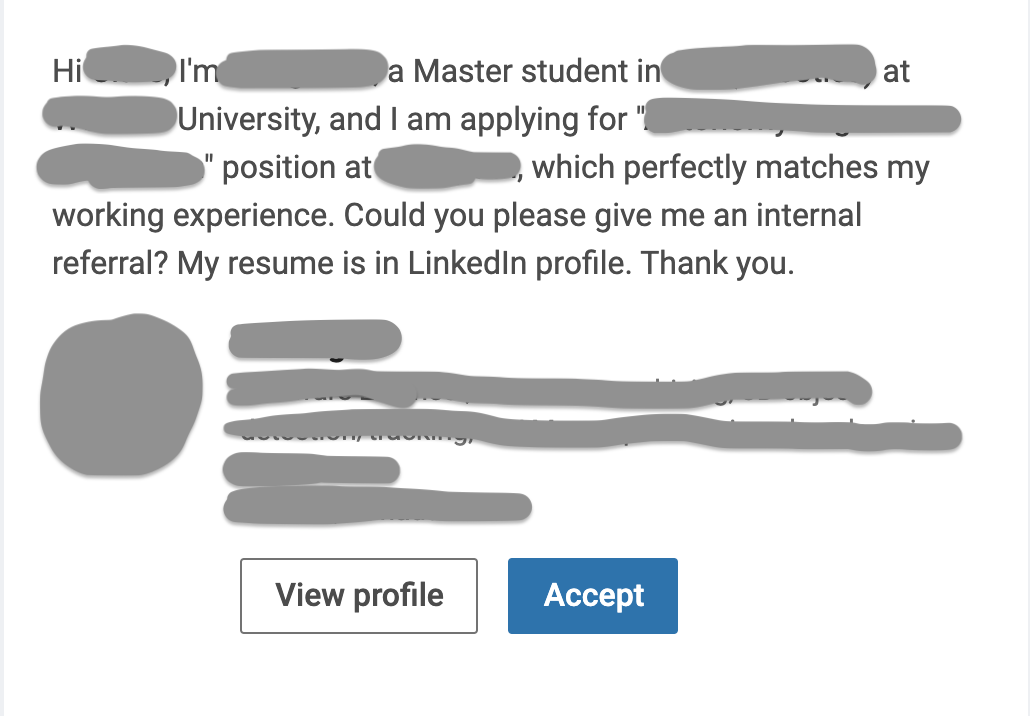 Here’s a new gimmick that I’ve seen recently: Some new grads in my field sent me LinkedIn invites with a generic but pushy message like the one shown here. In this message, this student was interested in a position in another department of my employer, said something vague why they’re a good match, stuffed keywords from the job description in their LinkedIn headline, and, mostly importantly, asked me for an internal referral.
If they’re students from my alma mater who would like an informational interview on my career, I’d be happy to set up a Zoom meeting with them. Asking me for an internal referral without knowing your work is stretching way too much.
Please tell your readers, especially the ones in career counseling, not to tell university students to ask a random alumni for an internal referral in the first encounter. The messages come across as overly pushy. I really wish career counselors would teach students to research the company and write a customized message to ask me for an informational interview first.
Yeah, that’s coming from people who don’t know how this works. Anyone conscientious isn’t going to recommend a stranger and asking for it, especially in this low-effort way, looks presumptuous and naive.
That said, at many companies there’s a difference between a referral and a recommendation, where with a referral you’re not saying much more than “this person came through me and they seem generally pleasant” (as opposed to a recommendation, where you’re saying you know and can vouch for the person’s work). And in that context, some people will refer just about anyone, especially if their company incentivizes referrals (like with bonuses if your referral gets hired).
However, the students writing to you don’t know if your company works like that, and either way it’s presumptuous to ask for a referral when they’ve never even talked to you. (And lots of people are going to take “referral” as meaning “recommendation.”) It doesn’t make a good impression, and you’re right that whoever is advising it needs to do a better job of what they’re teaching.
5. I’m burned out on my field
I’ve been working since I was 15 and I am now in my late 30’s. Mostly minimum wage jobs while completing my BA and MA. (I was ignorant about better options at the time.) Now, almost 12 years into my chosen profession, I have a series of short-term jobs on my resume ranging from three months to three years and I am facing total burnout.
I’m finishing up a year-long job at a crisis line, where there have been many high-stress incidents. It has been a lot to handle during coronavirus. Based on feedback from multiple managers and coworkers and repeated job offers from the same, I know that I am good at my job. But at what cost?
I really care about people and have not become jaded about behavioral health clients as many others have. I’m just tired. For me, the cost of genuine connection full-time is too much right now. I don’t overshare or cross boundaries, but I empathize easily and can almost always see both sides to an argument. I’ve seen more neutral colleagues do really well in the field long-term, but would argue that they are less individually effective and just more adept at dealing with a broken system.
I’ve noticed that several of your posts about job hopping are from people who are in behavioral health, like myself. Do you think that some of this is field-specific? Can I speak professionally about burnout as a reason to shift my career in future interviews without alarming potential employers? I have been asked about wanting to leave my field after all of my hard work, with hints from interviewers that this says something negative about me as a person.
Oh lord, yes, a lot of burnout is field-specific. People can get burned out in any field, of course, but you’re especially likely to see it in high-stress fields, including behavioral health. You just did a year at a crisis line! It’s no surprise you feel depleted.
If you’re trying to change fields, you can indeed cite burnout from an emotionally intense field as your reason. People will get it. As for it saying something bad about you as a person — you’ve worked in your chosen field for 12 years! That’s a good solid length of time, and it doesn’t reflect badly on you that you’re ready to do something else.
My hunch is that whatever concern you’re picking up on from interviewers is less about that and more about the series of short-term jobs, since that can make interviewers worry that you’re not really sure what you want to do and won’t stay long with them. I’d focus on revamping your resume to minimize that as much as you can (for example, take the three-month jobs off entirely; they aren’t long enough to strengthen you as a candidate and they’re adding to any impression of flightiness).
applying for jobs from work, using a work name and a social name, and more was originally published by Alison Green on Ask a Manager.
from Ask a Manager https://ift.tt/2SSKHv1




0 Comments